Poisoned Ground, Rising Flames: The Industrial Soil Contamination Crisis Fueling Suburban Wildfire Danger
For most Americans, wildfire risk is understood in terms of dry vegetation, low humidity, and wind-driven embers. The ground itself is rarely considered a variable. Yet across dozens of American communities — particularly those developed on or near former manufacturing corridors — the soil is not a neutral substrate. It is, in some cases, a fuel source.
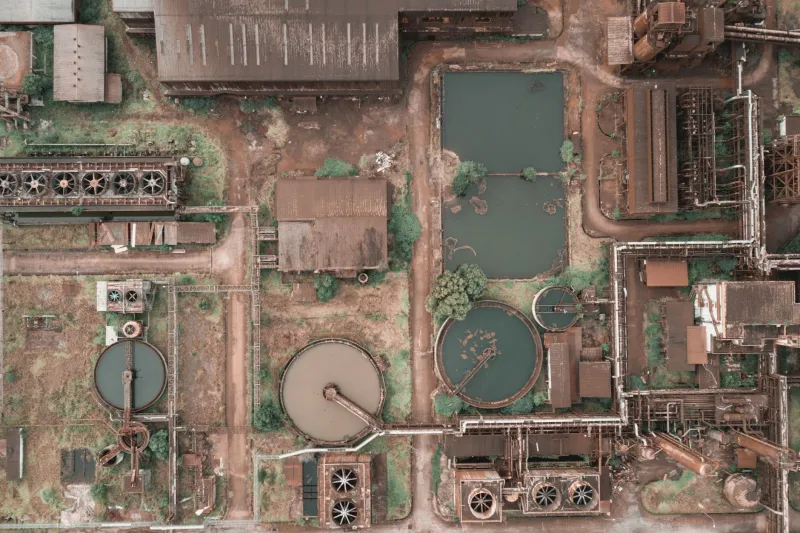
Decades of industrial activity have left behind a complex legacy of chemical contamination in American soil. Petroleum hydrocarbons, volatile organic compounds, polycyclic aromatic hydrocarbons, and residual solvents persist in the earth long after factories close and remediation efforts conclude. As suburban development continues to encroach on these formerly industrial zones, a troubling dynamic is emerging: the chemistry of contaminated soil can meaningfully lower ignition thresholds, accelerate surface fire spread, and intensify combustion in ways that standard wildfire models do not account for.
The Chemistry of a Contaminated Landscape
To understand why industrial soil contamination matters in a fire context, it helps to examine what these chemicals actually do to the physical properties of earth.
Healthy soil contains organic matter, mineral particles, and moisture — a combination that, under most conditions, resists ignition. Contaminated soil, particularly that saturated with petroleum derivatives or halogenated solvents, behaves differently. Hydrophobic compounds repel moisture, reducing the soil's natural ability to retain water and creating drier surface conditions even in moderate climates. Volatile organic compounds can off-gas under elevated temperatures, effectively priming the surrounding air with flammable vapors before a flame ever arrives.
Researchers at several U.S. universities studying brownfield sites — a term used by the Environmental Protection Agency to describe properties where expansion or redevelopment is complicated by known or suspected contamination — have documented measurably lower moisture retention in petroleum-affected soils. Lower moisture retention means faster drying of surface vegetation, which translates directly into higher fire susceptibility during drought or heat-wave conditions.
In some cases, the contaminants themselves become the fuel. Residual coal tar, a byproduct of historical gas manufacturing plants that operated in hundreds of American cities through the mid-twentieth century, has a flash point low enough to contribute meaningfully to ground-level combustion. Sites once occupied by dry-cleaning operations, automotive repair facilities, and chemical processing plants carry similar risks through their respective solvent residues.
Suburban Sprawl Meets Industrial Legacy
The geographic dimension of this problem is inseparable from broader patterns of American urban development. As housing demand has driven construction outward from city centers, former industrial land has become increasingly attractive for residential development. Brownfield-to-residential conversions accelerated significantly following federal incentives introduced in the early 2000s, and many communities across the Midwest, Mid-Atlantic, and Pacific Coast have since built neighborhoods on land with complicated environmental histories.
In the Chicago metropolitan area, for instance, entire residential subdivisions occupy land that once supported steel manufacturing, petroleum refining, and chemical production. Similar patterns exist in parts of New Jersey, California's Central Valley, and the former industrial belts of Pennsylvania and Ohio. Remediation of these sites is governed by EPA Superfund protocols and state-level environmental programs, but the standard for "clean" soil is calibrated primarily around human health exposure limits — not combustion behavior.
That regulatory gap is significant. A site can be formally cleared for residential development under existing environmental law while still harboring residual contamination levels that meaningfully affect its fire behavior. The two regulatory frameworks — environmental remediation and fire safety — have historically operated in separate silos, with little coordinated assessment of how chemical residues interact with wildfire risk.
The consequences of that disconnect are becoming harder to ignore. In Northern California communities near former industrial zones, fire investigators have noted anomalous burn patterns — areas where ground fires intensified or spread in directions inconsistent with prevailing winds and fuel loads. While definitive attribution to soil contamination remains scientifically challenging, the correlation has prompted growing interest among both fire scientists and environmental engineers.
Emerging Technologies for Soil-Based Fire Mitigation
The recognition that contaminated soil represents a fire risk variable — not merely a public health variable — has begun to generate a new category of applied research focused on soil treatment as a fire prevention tool.
Several approaches are showing early promise. Thermal desorption, a remediation technique that applies controlled heat to remove volatile contaminants from excavated soil, has long been used for environmental cleanup. Researchers are now examining whether targeted thermal treatment can simultaneously reduce both chemical contamination levels and the flammability characteristics of the treated material before it is returned to site.
Bioremediation — the use of microbial communities to break down organic contaminants — is another avenue gaining attention. Certain bacterial and fungal populations are highly effective at metabolizing petroleum hydrocarbons, and their activity not only reduces contaminant concentrations but also restores natural soil moisture dynamics over time. The challenge lies in the pace of biological remediation, which can span years or decades depending on contamination depth and soil composition.
More immediately applicable are surface-applied fire retardant amendments — materials mixed into the upper soil layer to suppress ignition potential and slow fire spread. Some formulations originally developed for agricultural applications have demonstrated effectiveness in reducing surface combustion rates in laboratory settings. Field-scale testing on brownfield-adjacent properties remains limited, but several research institutions, including groups affiliated with the U.S. Forest Service's fire sciences programs, have expressed interest in expanding this work.
On the detection side, advances in hyperspectral remote sensing are enabling more precise mapping of soil contamination across large areas. When overlaid with wildfire risk modeling data, these maps can identify specific parcels or corridors where chemical residues and fire-prone conditions converge — essentially producing a composite risk profile that neither environmental nor fire agencies currently generate on their own.
A Regulatory and Planning Blind Spot
Perhaps the most consequential aspect of this issue is the absence of any formal mechanism requiring joint assessment of contamination and fire risk in residential development approvals. Environmental impact reviews and fire hazard severity zone designations proceed through entirely separate processes, governed by different agencies, using different methodologies, and answering to different statutory mandates.
Advocates for integrated risk assessment argue that this structural separation is no longer defensible in an era of intensifying wildfire seasons and continued suburban expansion onto legacy industrial land. They point to the need for updated EPA guidance that incorporates fire behavior modeling into brownfield redevelopment approvals, as well as state-level building codes that require disclosure of soil contamination history to prospective residents in fire-prone zones.
For municipalities already grappling with the dual pressures of housing shortages and escalating fire risk, the ask is not a simple one. Comprehensive soil testing, integrated risk modeling, and remediation to fire-safe standards all carry significant costs. But the alternative — continuing to build communities on chemically altered ground without accounting for how that ground behaves in a fire — carries costs of its own, measured in property losses, displacement, and lives.
What Residents and Planners Should Know
For homeowners in communities near former industrial sites, the first practical step is awareness. EPA's public-facing Superfund and brownfield databases allow residents to search for known contaminated sites by address or zip code. State environmental agencies maintain supplementary records that often include more granular site-specific data.
For planners and developers, the emerging research argues for voluntary — and eventually mandatory — integration of soil flammability assessment into site evaluation protocols. Asking not only whether a parcel meets health-based cleanup standards, but also how its soil will behave under fire conditions, represents a meaningful expansion of due diligence that the current regulatory environment does not yet require but that sound risk management increasingly demands.
The ground beneath American suburbs has a history. In more places than most residents realize, that history is flammable. Acknowledging that fact — and engineering responses to it — is the next frontier in fire-resistant community design.