What's Settling in Your Attic Is Setting the Stage for Catastrophe
For most American homeowners, the attic is an afterthought — a dim, cramped repository for holiday decorations and forgotten luggage. What few consider is that the insulation lining that space may be quietly transforming into one of the most combustion-ready environments in the entire structure. The culprit is not the insulation itself, at least not initially. It is what accumulates within it over years of neglect: fine particulate matter that, under the right conditions, can accelerate a fire from manageable to catastrophic in a matter of seconds.
This is not a niche concern for older homes alone. It is a systemic problem embedded in the way American residential construction handles attic ventilation, insulation selection, and long-term maintenance — or more accurately, the lack thereof.
The Particulate Problem Most Inspections Miss
Dust, as a material, is deceptively dangerous. At the microscopic level, fine particulates present an enormous surface area relative to their mass. This characteristic is precisely what makes dust so combustible. When distributed throughout a porous medium like blown-in fiberglass or cellulose insulation, those particles become integrated into a matrix that retains heat, restricts airflow in unpredictable ways, and provides continuous fuel across a wide horizontal plane.
The problem is compounded by the fact that standard home inspections — even diligent ones — rarely account for particulate saturation in insulation. Inspectors typically assess insulation depth, visible moisture intrusion, and the presence of pests. They are not equipped, nor are they generally trained, to evaluate the combustibility profile of what has settled into the insulation fibers over a decade or more.
Fire safety engineers who work in residential forensics describe the issue in stark terms. The insulation may look intact from a casual visual assessment, but the dust loading within it can be substantial. Skin cells, textile fibers, wood particles, pollen, and combustion byproducts from HVAC systems all migrate upward and settle in attic spaces over time. In homes with inadequate vapor barriers or poorly sealed attic access points, the accumulation accelerates significantly.
How Dust Changes the Combustion Equation
To understand why this matters, consider the basic physics of ignition. A fire requires fuel, oxygen, and heat. Insulation alone — particularly modern fiberglass batts — is not highly combustible. But dust-laden insulation behaves differently. The fine particles dispersed throughout the material lower the ignition threshold considerably, while the insulation's own structure traps heat and limits the kind of airflow that might otherwise dissipate it.
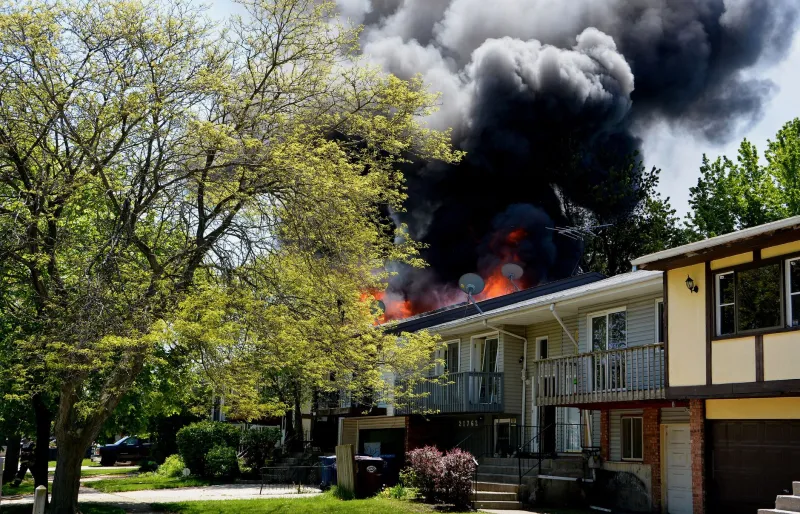
In the event of an attic fire — whether triggered by an overheated recessed light fixture, a faulty junction box, or an ember intrusion during a wildfire event — dust-saturated insulation does not simply smolder. It propagates. The fire moves laterally through the insulation layer with a speed and consistency that clean insulation would not support. Firefighters who have responded to attic fires in older homes frequently describe the experience as confronting a fire that seems to have no clear origin point because it has already spread across the entire attic floor.
This lateral propagation is precisely what makes attic fires so dangerous. By the time smoke detectors at the living-space level register the event, the fire may already occupy the full attic volume and have begun compromising the structural members of the roof.
Seasonal Peaks and the Drying Effect
The risk is not static throughout the year. Late summer and early autumn represent a particularly acute period in many parts of the United States, especially across the South, Southwest, and Pacific Coast regions where humidity drops sharply after the warm season. As attic spaces lose residual moisture, the dust-laden insulation becomes progressively drier, reducing its ignition threshold further.
Heating season introduces a separate set of concerns. When forced-air systems begin cycling regularly in late fall, the pressure differentials created by duct systems — particularly in homes where ductwork runs through the attic — can disturb settled particulates and redistribute them in ways that create concentrated fuel pockets. The same HVAC activity that makes a home comfortable is, in poorly maintained attic environments, stirring the conditions for a more severe fire event.
What Homeowners Can Actually Do
Prevention begins with access and visibility. Homeowners who have not physically inspected their attic insulation within the past five years should prioritize doing so, ideally before the heating season begins. The visual indicators of problematic particulate loading include insulation that appears discolored — typically gray or brown rather than its original white or pink — and a surface texture that looks compressed or matted rather than fluffy and uniform.
For homes with blown-in cellulose insulation, the risk profile is somewhat different. Cellulose is treated with fire retardants at the time of installation, but those treatments degrade over time, particularly in attics that experience high humidity fluctuations. A cellulose installation that is fifteen or twenty years old may have lost a meaningful portion of its original fire resistance, and if it has also accumulated significant particulate matter, the combination warrants serious attention.
Professional attic remediation services — distinct from standard insulation contractors — can assess particulate loading and recommend appropriate responses. In some cases, a thorough air-sealing of penetration points, combined with HVAC duct inspection and sealing, will substantially reduce ongoing accumulation. In others, particularly older homes where the insulation itself has degraded, full removal and replacement with a modern, fire-resistant product is the more defensible choice.
Homeowners in wildfire-prone regions should also consider ember intrusion as a specific threat vector. Embers entering through attic vents during a wildfire event land directly on insulation surfaces. In a dust-saturated attic, a single ember that would otherwise self-extinguish on clean insulation may find enough fine fuel to sustain ignition. Ember-resistant attic vents, which are now widely available and recognized in updated building codes across California and other high-risk states, represent a relatively low-cost intervention with a significant protective return.
The Inspection Gap That Needs Closing
Perhaps the most consequential issue is not the dust itself, but the absence of any standardized protocol for evaluating it. Home inspection standards in the United States, governed largely by trade organizations and varying by state, do not currently require assessors to evaluate particulate combustibility in insulation. This is a gap that fire safety professionals have been raising for years without sufficient traction in either the regulatory or insurance sectors.
Until that gap closes, the responsibility falls to individual homeowners. Scheduling a dedicated attic inspection — one that goes beyond the cursory glance most inspectors provide — is an act of protection that costs relatively little against the alternative. The attic is not merely storage space. In a fire scenario, it is the room that determines whether the rest of the structure survives.
The insulation that was installed to keep your home warm may, over years of accumulation, be quietly preparing to do the opposite. Addressing that reality is not alarmism. It is the kind of deliberate, evidence-based protection that durable homes are built upon.