When Water Weakens the Wall: The Hidden Link Between Moisture Damage and Fire Vulnerability in American Homes
The average American homeowner who discovers a water stain on the ceiling or a soft patch of drywall typically responds with a single, narrow concern: mold. The health implications of fungal growth are well-documented, widely publicized, and legitimately alarming. What receives far less attention, however, is what moisture damage does to the structural and fire-resistant integrity of the walls themselves — and how that degradation can transform a manageable house fire into a catastrophic one.
Fire safety engineering is, at its core, a science of time. The longer a structure can resist ignition and contain flame spread, the more time occupants have to escape and first responders have to intervene. When the materials engineered to buy that time are silently compromised by moisture and biological decay, the entire calculus changes — often without the homeowner ever knowing.
The Architecture of Fire Resistance
To understand what moisture destroys, it helps to first understand what fire-resistant wall assemblies are designed to do. Modern residential construction in the United States relies on a layered system of protection. Gypsum wallboard — commonly known as drywall — forms the innermost layer and is the primary fire-resistive component in most wall assemblies. Gypsum's effectiveness stems from its chemical composition: the material contains calcium sulfate dihydrate, which releases water vapor when exposed to heat, absorbing thermal energy and slowing the spread of flame and gases into the wall cavity.
Beyond the drywall, insulation materials — whether fiberglass batts, mineral wool, or spray foam — occupy the stud bays and contribute to thermal resistance. Fire-blocking elements, typically horizontal framing members or packed mineral wool at specific intervals, are required by building codes to interrupt the vertical channels through which fire and smoke travel inside walls.
This system, when intact and dry, performs reliably. The problem begins the moment sustained moisture enters the equation.
How Water Rewrites the Fire-Safety Blueprint
Gypsum wallboard is notably vulnerable to prolonged water exposure. When moisture penetrates the paper facing and saturates the gypsum core, the board softens, loses structural cohesion, and begins to crumble. In severe cases, the calcium sulfate matrix itself is disrupted. A compromised gypsum panel no longer functions as a continuous fire barrier — it becomes a porous, weakened surface riddled with micro-fractures that allow heat and combustion gases to penetrate far more rapidly than intact material would permit.
The degradation doesn't stop at the surface. Inside the wall cavity, persistent moisture creates ideal conditions for wood rot in the framing members. Dimensional lumber that has been weakened by fungal decay loses both its structural strength and its resistance to combustion. Healthy wood chars predictably under fire conditions, forming a protective carbonized layer that slows further ignition. Rot-damaged wood, by contrast, burns inconsistently and can ignite at lower temperatures, undermining the predictable fire behavior that engineers rely upon when designing safe structures.
Fire-blocking elements are equally susceptible. Horizontal blocking members installed to interrupt vertical fire pathways can be rendered ineffective when rot compromises their fit within the stud bay, creating gaps that become unobstructed channels for flame travel. In older homes — particularly the tens of millions of pre-1970s structures still occupied across the United States — these gaps may already exist due to decades of thermal movement and settling. Moisture accelerates and amplifies this process.
Mold as an Indicator, Not Just a Health Hazard
Visible mold growth on interior wall surfaces is frequently treated as the primary problem to be remediated. In the context of fire safety, however, mold is better understood as a symptom — a visible indicator that moisture has been present long enough and in sufficient quantity to sustain biological activity. By the time mold is apparent on a finished surface, the conditions behind that surface have typically been compromised for weeks or months.
Certain mold species produce metabolic byproducts that can accelerate the decomposition of cellulose-based materials, including the paper facing on gypsum board and the wood fibers in structural framing. While the direct contribution of mold metabolites to combustion chemistry remains an area of ongoing research, the mechanical degradation they facilitate is well-established. A wall cavity colonized by active mold growth is, by definition, a wall cavity in which protective materials are actively deteriorating.
Fiberglass batt insulation, one of the most common cavity fill materials in American residential construction, does not support mold growth itself — but it readily absorbs and retains moisture, creating sustained wet conditions that accelerate decay in adjacent wood and gypsum components. Cellulose insulation, produced from recycled paper and widely used in retrofit applications, presents an additional concern: while it is typically treated with fire-retardant borate compounds, prolonged moisture exposure can leach those treatments from the material, diminishing its fire-resistive properties over time.
The Electrical Compounding Factor
Moisture-damaged wall cavities carry an additional fire risk that operates independently of structural degradation: electrical hazard. The United States has an enormous stock of aging residential wiring, and within wall cavities, junction boxes, outlet receptacles, and wire runs are frequently located in close proximity to insulation and framing. When moisture infiltrates these spaces, it can cause corrosion at electrical connections, degrade wire insulation, and create conditions conducive to arcing.
An electrical arc event in a dry, intact wall cavity may be contained by the surrounding fire-resistant materials. The same event in a cavity where gypsum has crumbled, wood has partially decayed, and insulation has been saturated presents a fundamentally different scenario. The ignition source encounters compromised materials rather than engineered barriers, and the outcome can escalate with alarming speed.
Practical Implications for Homeowners
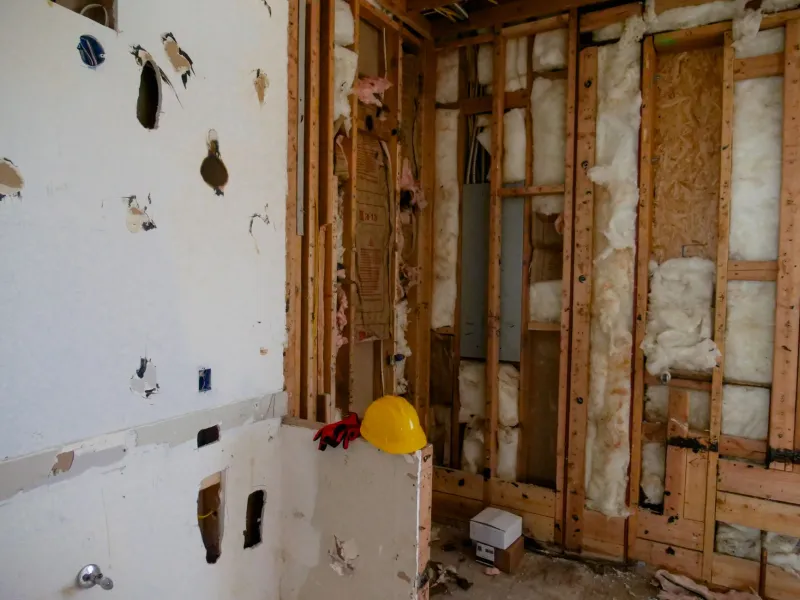
The intersection of moisture management and fire safety carries clear practical implications. Homeowners undertaking water damage remediation should treat the process as a fire-safety intervention, not merely a mold-abatement exercise. This means evaluating the condition of gypsum wallboard and replacing panels that have been saturated or structurally compromised — not simply drying them in place. It means inspecting framing members for signs of fungal decay and addressing structural deficiencies before closing walls. It means verifying that fire-blocking elements remain intact and properly fitted after any remediation work.
Building inspectors and contractors performing post-water-damage assessments are not universally trained to evaluate fire-resistance implications. Homeowners should ask specifically about the condition of fire-blocking, the integrity of gypsum assemblies, and the status of any treated insulation materials that may have been exposed to prolonged moisture.
In new construction, proper vapor barrier installation, adequate attic and crawlspace ventilation, and prompt response to roof or plumbing leaks are the most effective preventive measures available. The building codes governing these elements exist for reasons that extend well beyond mold prevention.
A More Complete Definition of Home Fire Safety
The dominant narrative around residential fire safety in the United States focuses on detection — smoke alarms, carbon monoxide detectors, sprinkler systems. These technologies are invaluable. But detection is a response to fire, not a prevention of it. The structural integrity of the walls, floors, and ceilings that separate occupants from ignition sources and slow the spread of flame is the foundational layer of protection upon which every other safety measure depends.
When moisture silently erodes that foundation, it does so without triggering alarms or generating visible warnings. The wall looks intact from the living room. The smoke detector remains silent. And yet the engineered protection that residents rely upon has been quietly, incrementally diminished.
Addressing moisture intrusion promptly and comprehensively is not merely a matter of indoor air quality or structural maintenance. It is, in the most direct sense, a matter of fire safety — and it deserves to be treated as one.